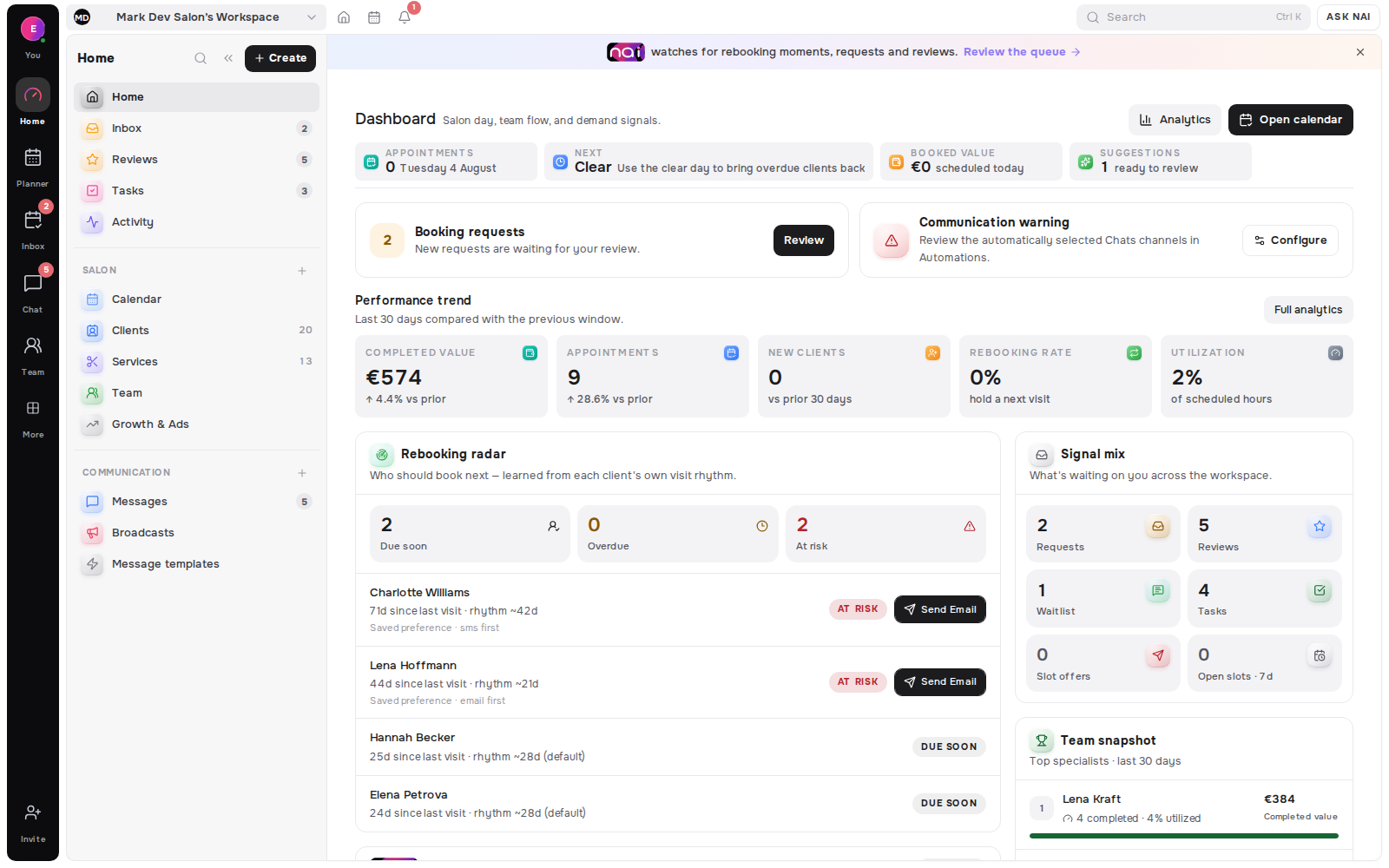
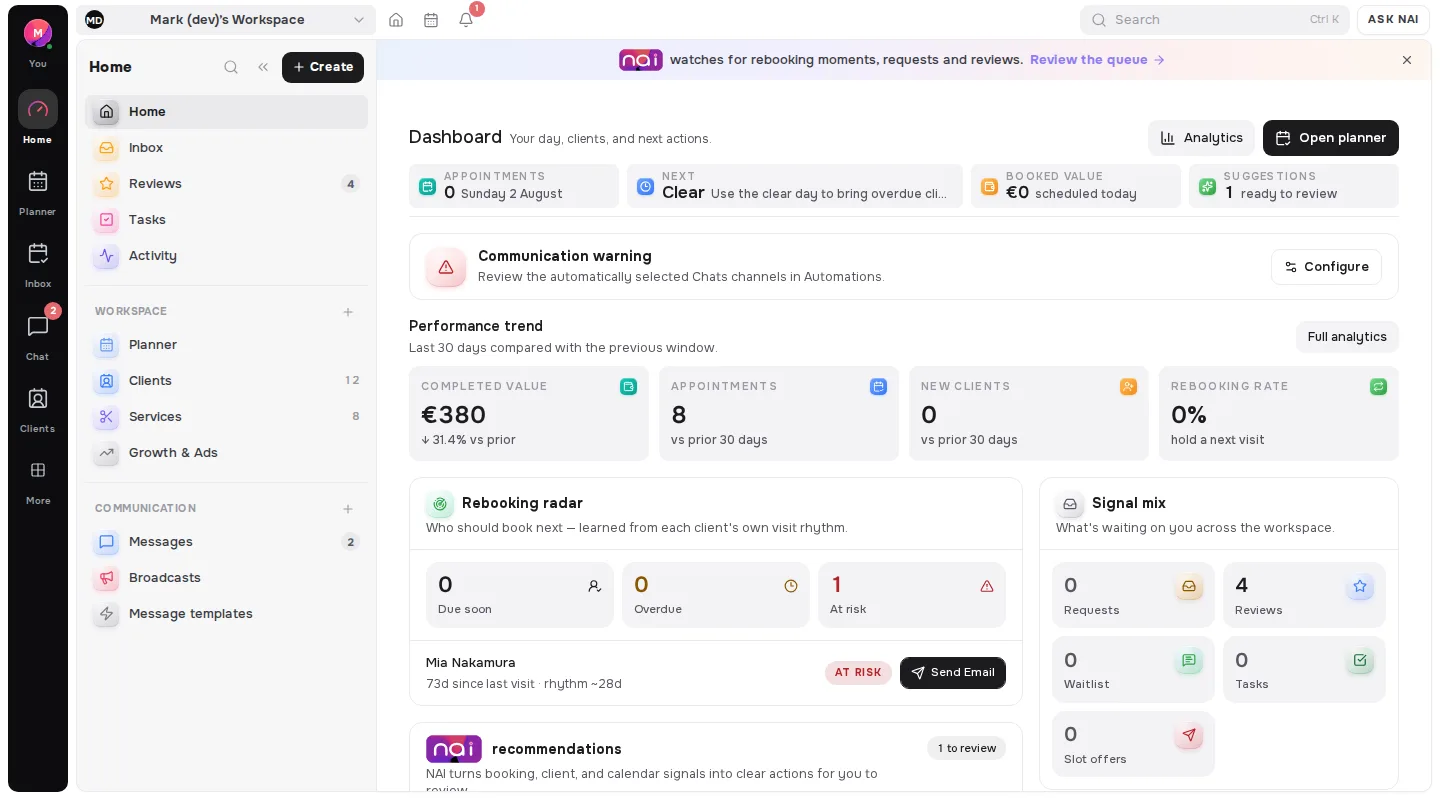
Rebooking rate measures how often a finished visit produces the next one. Client retention measures how many people come back at all within a period you choose. They are not two names for the same number, and neither has an agreed industry definition - the window you pick changes the result more than anything you do in the salon. Fix your own window first, write it down, and use the same one in every report. A rebooking rate quoted without its window is not a metric, it is a mood.
This is the most confusing pair of numbers in appointment-based businesses, and the confusion is not the operator's fault. Different systems draw the line in different places, so the same book of clients can produce sharply different rebooking rates depending on rules nobody made explicit.
Key takeaways
- Rebooking measures a moment; retention measures a period. They are not interchangeable.
- Neither has an industry-standard window, so the number is meaningless until you fix and write down your own.
- Exclude what could never repeat - for example one-off consultations and event bookings.
- Split new clients from returning ones, or both signals disappear into the average.
- Compare your number only against your own history, never against a published benchmark.
The two numbers answer different questions
Rebooking rate answers: when someone was in my chair, did we agree on the next visit? It is a question about the moment the visit ends. It is operational, it moves quickly, and it responds directly to what you do and say at the end of an appointment.
Retention answers: of the people who could have come back, how many did? It is a question about a period, not a moment. It moves slowly, it reflects everything - result quality, price, convenience, competition - and it cannot be fixed in a single conversation.
Confusing them leads to the wrong action. A falling rebooking rate is usually a habit problem you can change this week. A falling retention rate is usually a business problem that took months to build.
Rebooking rate: the formula and the one decision that changes it
Rebooking rate = completed visits that produced a next booking ÷ all eligible completed visits × 100
The formula is trivial. The decision underneath it is not. What counts as "produced a next booking"?
There are three common answers, and each gives a different number for the same week:
- Booked before leaving. Only visits where the next appointment was made on the spot. The strictest reading, and the one that measures your closing habit most honestly.
- Booked within a short window. The next appointment was made within a day or two of the visit - on the spot, or after a same-evening message. Looser, and more forgiving of clients who check their calendar at home.
- Booked at any point before the next visit. Effectively everyone who ever came back. This is not a rebooking rate; it is retention wearing a different name.
Pick one. The first two are both defensible. The third is the reason so many reported rebooking numbers are unusable.
Retention: the formula and the trap in the denominator
Retention rate = clients who returned within the period ÷ clients who could have returned × 100
The numerator is easy. The denominator is where the number is won or lost, because "could have returned" is a judgement, not a fact.
A client whose service is done every six weeks cannot be counted as lost after four. Including them in a 30-day retention figure drags the number down and tells you nothing. The denominator has to be built from people whose normal interval has actually elapsed - which means retention only makes sense once you know the typical interval per service, not per business.
This is also why a single company-wide retention number is close to meaningless when your services have intervals of two weeks and four months sitting side by side.
Why two identical businesses report different numbers
Take two specialists with the same clients, the same schedule and the same results. Their reported figures can differ by thirty points, entirely because of choices nobody wrote down:
- one counts the window as same-day, the other as any time before the next visit.
- one includes first-time visits in the denominator, the other excludes them.
- one counts a client who rebooked and then cancelled, the other does not.
- one includes one-off services nobody repeats, the other filters them out.
- one measures over 30 days, the other over 90.
None of these is wrong. All of them have to be written down, or the number cannot be compared to last quarter, let alone to anyone else.
What to exclude, and why
Three categories distort both metrics and should usually come out of the denominator:
One-off services. A single consultation, a one-time repair, a service someone booked for an event. They were never going to repeat, and counting them as failures to return is self-punishment.
Visits that ended badly through no fault of the loop. A client who moved city, a service that was medically discontinued. These belong in a note, not in a rate.
First visits, when you are measuring the rebooking habit. A first-time client behaves differently from a regular, and mixing them hides both signals. Which brings us to the split that matters most.
New and returning clients are not one population
This is the single most useful cut you can make, and it is the one most often skipped.
A new client who does not rebook is a signal about your first-visit experience: whether they understood the result, whether the price landed as expected, whether anyone asked about the next visit at all. A regular client who stops rebooking is a completely different signal - something changed, and it changed recently.
Averaging them together produces a number that moves without telling you why. Splitting them turns the same data into two questions you can actually act on.
What to do with the number once you have it
A metric that does not change behaviour is overhead. Two uses justify the effort.
The first is timing. If you know the typical interval per service, you know when a client is due - and that is the input to the return loop rather than a report line. We wrote about how those completed visits turn into a return signal in the client who comes back.
The second is the empty slot. Rebooking and retention describe demand you already have. When that demand outruns your calendar, the constraint moves to how gaps get filled, which is a different discipline entirely - see how to fill a last-minute cancellation.
Start smaller than you think. Write down your window, exclude one-off services, split new from returning, and measure the same way for three months before drawing any conclusion. A consistent imperfect definition beats a perfect one you change every quarter.
Is there evidence that the window choice matters?
There is, and it comes from healthcare rather than beauty - which is useful, because the measurement problem is identical.
Published return studies almost always name their window explicitly. A randomised trial of a prompt message after a missed appointment reports return within 30 days: 22.2% (randomised clinical trial, 2024) for the intervention against 11.6% (2024 trial) for the control. Change the window to 90 days and both numbers rise; the intervention effect may not. That is the whole argument for fixing your own window before quoting a rate.
Lead time distorts the denominator too. Nonarrival climbed by roughly 16% (scheduling horizon analysis, 2020) per extra 30 days of booking horizon. It exceeded 50% (2020 analysis) past 90 days. So a business that books far ahead will show a healthy rebooking rate and a poor attendance rate at the same time. Both are true. Only together are they meaningful.
Finally, a rebooking is not a completed visit. In a nine-month operational study, offers accepted did not all convert: 6,703 acceptances produced 5,399 completed visits (self-rescheduling cohort study, 2024). If your rate counts bookings made rather than visits completed, say so.
FAQ
What is the difference between rebooking rate and retention?
Rebooking measures a moment - did the finished visit produce the next booking. Retention measures a period - did the client come back at all within a window you chose.
Which window should I use?
Whichever matches your service interval, applied consistently. Published studies state theirs explicitly (randomised clinical trial, 2024); a rate quoted without its window cannot be compared to anything.
Should first visits count?
Not when you are measuring the rebooking habit. New and returning clients behave differently, and averaging them hides both signals.
Do cancelled rebookings count?
Decide once and write it down. Acceptances and completed visits diverge measurably (2024 cohort study), so the two definitions give different numbers.
Can I compare my number to an industry benchmark?
Not safely. Vendors define the window differently, so published benchmarks are rarely measuring the same thing.
[UNIQUE INSIGHT] Why no benchmark for this number is trustworthy
Every published study of return behaviour we cite above names its window in the abstract, because the authors know the number is meaningless without it. Commercial reporting does the opposite: a rebooking rate is quoted as though it were a property of the business rather than of the measurement rule.
That asymmetry is the whole problem. A clinical trial says "within 30 days" and can be replicated. A vendor dashboard reports a single rebooking percentage and cannot. You cannot see which rule produced it, for instance whether it counted bookings made on the spot, bookings made that evening, or anyone who ever came back. Those three rules describe three different businesses.
The practical consequence is uncomfortable and worth stating plainly. You cannot compare your rebooking rate to anyone else's, and you should stop trying. The only comparison that carries information is your own number against your own number. Measure it the same way, over enough months for the seasonal noise to cancel. Everything else is a vanity metric with a decimal point.
[ORIGINAL DATA] One vendor publishes the formulas, so here they are
Methodology. On 19 August 2026 we requested the public reporting documentation of six booking and salon platforms with a standard HTTP client. We were looking for one thing: a written formula for retention or rebooking. Sample size: one vendor publishes both formulas, one discusses the concepts without numbers, and four returned errors or blocked the request. Only wording printed on the vendor's own page is quoted.
Square defines both metrics in its appointment performance report, and the definitions are worth reading closely.
Client retention is "a ratio defined as the number of returning clients divided by the number of total clients. A return client is defined as a client that visited within a year before the date range".
Pre-booking is "a ratio defined as the number of visits when the client pre-booked divided by their total number of visits. To qualify as a pre-booking, a client must book at least one future appointment within 24 hours of their current appointment end time".
Fresha writes about retention reporting in general terms, tracking "demographics, purchase history, and feedback", without a visit count, a window, or a formula. Mindbody's salon report page returned a loading error to a non-browser request. Acuity and Booksy returned HTTP 403 and are marked unverified.
| Metric. | Published definition. | What it actually counts. |
|---|---|---|
| Client retention. | Returning clients ÷ total clients, return = visited within a year before the range. | Share of this period's clients who are not new. |
| Pre-booking. | Visits with a pre-booking ÷ total visits, within 24 hours of the appointment end. | A checkable event with a clock on it. |
| Fresha equivalent. | None published. | Not comparable. |
| Mindbody · Acuity · Booksy. | Unverified - loading error or HTTP 403. | Unknown. |
[UNIQUE INSIGHT] Read the retention formula slowly and it is not measuring what the word implies. The denominator is clients with a visit inside your chosen range. The numerator is those who had also visited in the year before it. That is the share of this period's clients who are not new, which is a mix, not a return rate. A quiet month with only regulars scores high. A great month full of new clients scores low, and the owner is told retention fell. The pre-booking formula is the opposite. It is narrow, explicit and checkable, because "within 24 hours of the appointment end" is a fact rather than an interpretation. If you want one number you can compare across months and across staff, take the one with the clock in it.
Definitions used in this article
Rebooking rate is the share of completed visits that produced a next booking, measured inside a window you define.
Client retention is the share of clients who returned at all within a chosen period.
The measurement window is the rule that decides what counts, and it changes the result more than any change you make in the room.
Eligible visits are the completed visits that could reasonably have produced a return - one-off services and first visits usually do not belong in that denominator.
Where these numbers live in Belom is booking and revenue analytics.
Editorial note: written by the Belom product team from how the product actually works, not from vendor marketing. More about Belom, or contact us with a question. Reviewed 19 August 2026.