
Pick the language your clients book in, not the one you market in. In Estonia that usually means Estonian and Russian carry the bookings while English carries discovery. Translate the parts a client reads to decide, for instance service names, durations, preparation notes and cancellation rules. Leave alone the parts that only look like language: prices, dates and addresses are formatting, not translation.
The decision matters more than it looks. A booking page is not a brochure. Every line on it is either helping someone choose a service or stopping them, and a client who cannot tell whether "Hooldus" means a refill or a full new set will close the tab rather than ask.
Key takeaways
- Choose the language your clients book in, not the one you market in - read your last thirty messages to find out which that is.
- Translate what a client reads to decide: service names, durations, preparation, cancellation rules.
- Do not translate formatting, such as street names, prices and dates. A translated street name puts someone on the wrong corner.
- Keep one catalogue and one calendar behind however many languages you show.
- Write policy text natively in each language rather than converting it - tone does not survive a literal translation.
Start from how clients already write to you
Before choosing a default, look at your last thirty conversations. Not your follower count, not your city demographics - the actual messages sitting in your inbox. If two thirds of them arrive in Russian, a page that opens in Estonian adds friction to two thirds of your bookings.
This is also the cheapest possible research. You already have the data, and it is more accurate than any assumption about your market, because it reflects the people who found you specifically.
If your messages are spread across several channels, the picture is easier to read when the conversations sit in one place. That is a separate operational problem, and we wrote about it in one inbox for WhatsApp, Instagram, Telegram and SMS.
Estonian, Russian, English do different jobs
They are not three versions of the same audience.
Estonian is the default for local search and for clients who expect a local business to speak the local language. It is also the language most likely to be read by someone comparing you to a salon two streets away.
Russian carries a large share of actual bookings in Tallinn, Narva and Ida-Viru County. Treating it as an afterthought translation is the most common mistake, because for a significant part of your client base it is not the second language - it is the only one they will read carefully.
English is discovery and newcomers: people who moved recently, are visiting, or found you through an international channel. It converts less per visit but removes a hard barrier for a client who would otherwise not book at all.
You do not need all three on day one. You need to know which one is doing the work.
Service names are the trap
Everything else on a booking page tolerates an imperfect translation. Service names do not, because the client is not reading them - they are choosing from them.
Three rules keep them usable:
Do not translate a term your clients do not use. If everyone in the room says "gel", "гель" and "geel", write that. A technically correct Estonian noun that no client has ever said out loud will lose to the borrowed word every time.
Keep the distinction visible in every language. If your catalogue separates a first application from maintenance, that difference has to survive translation. "New set" and "refill" collapsing into one word in another language means clients booking the wrong duration, which means your day breaks.
Keep the same structure across languages. The order of categories, the way add-ons are named, the way length or size appears - if these differ per language, you are maintaining three catalogues instead of one, and they will drift.
Prices, dates and addresses are formatting, not language
This is where automatic translation quietly does damage.
A price is a number and a currency, and it should look the same everywhere with only the separator adapting. A date should be unambiguous - a numeric-only date read by a client used to a different order is a missed appointment waiting to happen; spelling out the month removes the risk. An address should never be translated at all: street names go in the form the client will type into a map, and a translated street name is a client standing on the wrong corner.
Duration is worth one extra thought. "75 min" reads the same in all three languages and is safer than a phrase.
One page in several languages, not several pages
The instinct is to build a page per language and link them. It creates more problems than it solves: three pages drift apart, availability has to be maintained in three places, and search engines treat them as competing pages unless you declare the relationship correctly.
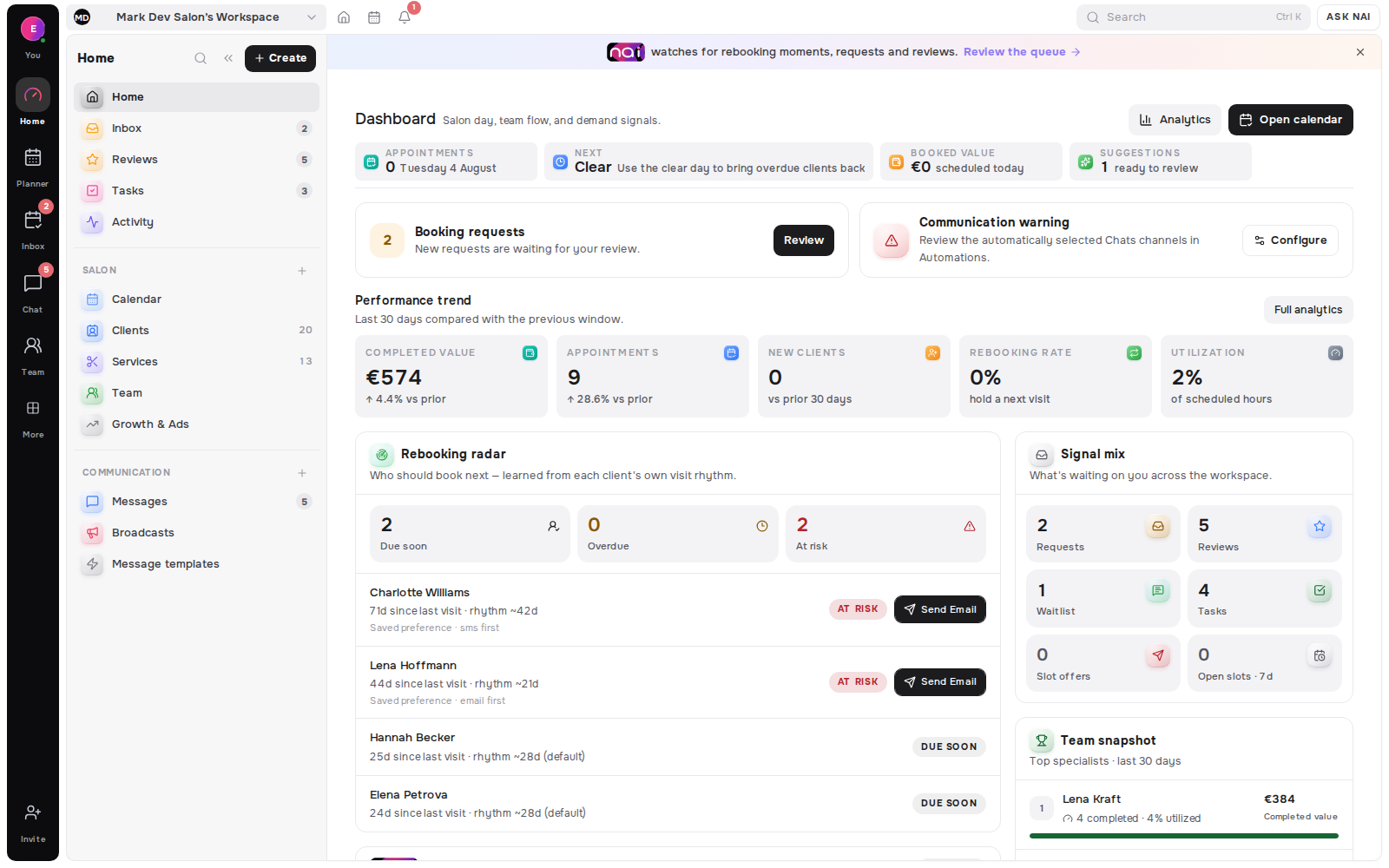
The workable shape is one profile whose content exists in several languages, with one set of services, one calendar and one set of rules underneath. In Belom the public profile carries fifteen languages this way, so a client opening your link sees their own language while you keep a single catalogue and a single schedule behind it.
Practically that means when you add a service, you add it once. When you change a price, it changes everywhere. The alternative - three separate pages maintained by hand - fails on the first busy week.
Cancellation rules need the most care
Policy wording is the one place where a literal translation is actively dangerous.
The same sentence carries different weight in different languages. A rule that reads as reasonable and matter-of-fact in Estonian can read as cold or threatening in Russian if translated word for word, and the client's reaction is not "fair enough" but "I will not book here". The information must be identical; the tone has to be written natively.
Write the rule once in plain terms - how much notice you need, what happens if it is shorter, what happens with illness - then have each language written rather than converted. Where it appears in the booking flow matters as much as the wording, and it belongs before confirmation, not after.
How to decide, in order
- Read your last thirty client messages and count the languages.
- Make the most frequent one your default.
- Add the second language fully - services, durations, rules - before adding a third partially.
- Write policy text natively in each language, not as a translation.
- Keep one catalogue and one calendar underneath all of them.
- Check the empty state in every language: a client who finds no free times should see the same helpful path regardless of which language they opened. That state is worth designing deliberately, and we covered it in what your booking page should show when there are no free times.
A multilingual booking page is not a translation project. It is a decision about which language your business actually works in, followed by the discipline of keeping one catalogue behind however many languages you show.
What do the official numbers actually tell you?
Two things, and the second is more useful than the first.
Estonia is unusually multilingual. In the EU Adult Education Survey, 95.5% (Eurostat, foreign language skills, 2022) of working-age adults reported knowing at least one foreign language, against an EU average near 74.7% (Eurostat, 2022). Only a handful of member states clear 90% (Eurostat AES).
That cuts both ways. It means an English booking page locks out fewer people here than almost anywhere else in Europe. It also means knowing a language is not the same as wanting to transact in it - competence is high, preference is still preference.
And this is where the evidence runs out. The EU's dedicated survey of online language preference is Flash Eurobarometer 313, fielded in 2011 across 27 member states with 13,752 interviews (Publications Office, Flash Eurobarometer 313). That is old enough that any figure from it describes a pre-smartphone internet.
So the honest instruction is the one in this article rather than a statistic: read your last thirty client messages. Your own inbox is more current than the published evidence, and it describes your clients rather than the average European.
FAQ
Should my booking page default to Estonian?
Default to whichever language most of your incoming messages arrive in. National averages describe the country, not your client list.
Is an English-only page viable in Estonia?
More viable than in most of Europe, since foreign-language knowledge is high (Eurostat, 2022) - but competence is not preference, and a client choosing a service reads more carefully than one browsing.
Do I need all three languages from day one?
No. Add the second language completely - services, durations, rules - before adding a third partially.
Can I machine-translate the service names?
No. Service names are chosen from, not read, and a term your clients never say will lose to the borrowed word every time.
What should never be translated?
Street names, prices and dates. Those are formatting, and a translated street name puts a client on the wrong corner.
[UNIQUE INSIGHT] The evidence base for this decision is older than the smartphone era
Methodology note. Before writing this article we looked for current, official data on which language people prefer to transact in online, restricted to EU statistical sources. What exists is the Adult Education Survey for language knowledge, and one dedicated survey of online language preference - fielded in 2011.
That gap matters more than any single figure. Language knowledge is measured regularly and carefully; language preference at the moment of buying is not measured at all in current EU statistics. So every confident claim you read about "customers prefer their own language" is either extrapolated from a pre-smartphone survey or from vendor marketing.
The honest conclusion for a booking page is therefore methodological rather than statistical: there is no current authoritative number to defer to, which makes your own inbox the best available evidence. Thirty recent conversations describe your clients in 2026. A 2011 survey describes a different internet, and a national average describes a country rather than a client list.
[ORIGINAL DATA] Which languages the big platforms actually serve
Methodology. On 19 August 2026 we requested the language paths of two international booking platforms with a standard HTTP client and recorded the status code each returned. Sample size: 14 language paths on Fresha and 13 locale paths on Booksy, one request each, no retries. This measures the public marketing site, not the client-facing booking widget, which may be localised separately.
Fresha returned a page for Lithuanian, Finnish, Polish, Russian, German, Spanish, French, Italian, Swedish, Danish and Dutch. It returned HTTP 404 for Estonian and Latvian.
Booksy served Polish, English, Spanish, German and Russian. Requests for the Estonian, Latvian, Lithuanian and Finnish locales were redirected with HTTP 302 to the English page.
| Language. | Fresha. | Booksy. |
|---|---|---|
| Estonian. | HTTP 404. | HTTP 302 to English. |
| Latvian. | HTTP 404. | HTTP 302 to English. |
| Lithuanian. | HTTP 200. | HTTP 302 to English. |
| Finnish. | HTTP 200. | HTTP 302 to English. |
| Russian. | HTTP 200. | HTTP 200. |
| Polish. | HTTP 200. | HTTP 200. |
[UNIQUE INSIGHT] The asymmetry is the finding. Both platforms serve Russian and neither serves Estonian, which inverts the assumption most Estonian owners start from. If you decide your booking page should lead in Estonian, the constraint may not be your writing or your clients. It may be that your tool has no Estonian to render, and no amount of good intent at your end changes a 404 at theirs. That is worth checking before the language debate rather than after, because it turns an open question into a shortlist. The practical order is: find out which languages your tool can actually display, then decide which of those your clients read, and only then argue about tone.
Definitions used in this article
The default language is the one your booking page opens in before a client changes anything.
Language knowledge is whether someone can read a language; language preference is which one they choose to transact in. EU statistics measure the first regularly and the second barely at all.
Localisation is rewriting for a market - tone, examples and rules - while translation only converts words.
Formatting covers prices, dates and addresses, which must adapt in shape but never be translated in substance.
The multilingual public profile in Belom is part of online booking.
Editorial note: written by the Belom product team from how the product actually works, not from vendor marketing. More about Belom, or contact us with a question. Reviewed 19 August 2026.